A first-time homeowner's guide to hiring a concrete contractor
By Rod Burnett · Updated 2026-07-08
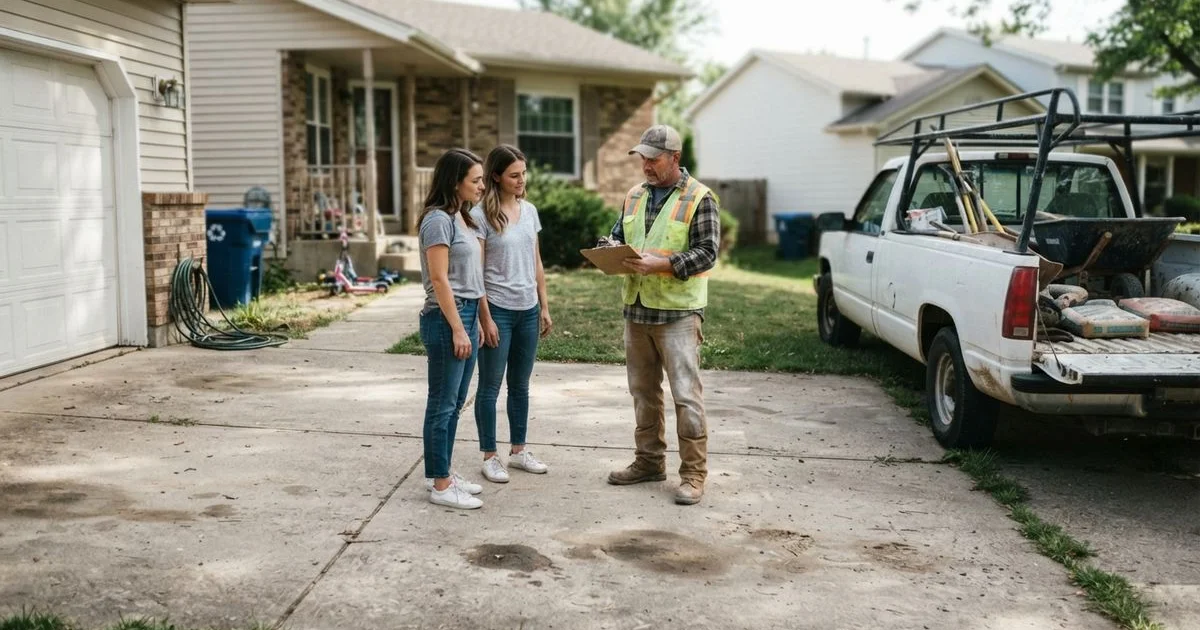
Hiring your first concrete contractor without a frame of reference is one of those tasks that feels riskier than it needs to be. A structured process removes most of the guesswork. If you’re hiring for a business property rather than your own home, our guide on commercial and industrial concrete covers what’s different about that process.
Step 1: Define the project clearly
Before contacting anyone, get specific: exact area (measure it or estimate it as closely as you can), the finish you want, and any constraints like site access or a target completion date. A vague description (“new driveway, medium size”) gets you vague, hard-to-compare quotes.
Step 2: Get a ballpark before you call anyone
Use a cost estimator to get a rough sense of what your project should cost before requesting quotes. This does not replace a real quote, but it protects you from being anchored entirely by whatever number the first contractor tells you.
Step 3: Shortlist based on more than star rating
A 4.8-star business with 12 reviews and a 4.6-star business with 300 reviews are not equally reliable signals. Look for consistency in the actual review content, specifically whether recent reviews mention the kind of work you need and whether complaint patterns show up repeatedly (communication issues, missed timelines, unresolved corrections) rather than being one-off. Our directory homepage sentiment-scores contractors on exactly this kind of pattern, not just the raw star average.
| Signal | Why it matters more than the star average alone |
|---|---|
| Recency of reviews | Shows current, not historical, performance |
| Review volume | A handful of reviews is a thin sample |
| Recurring complaint themes | One bad review is noise; a repeated theme is a pattern |
| Licensing and insurance | Confirms accountability if something goes wrong |
Step 4: Get three quotes, itemized the same way
Ask each contractor for the same breakdown: slab thickness, reinforcement type, finish, site prep included, and whether demolition of any existing concrete is part of the price. This is the only way to compare quotes as apples to apples instead of guessing at what is baked into each number.
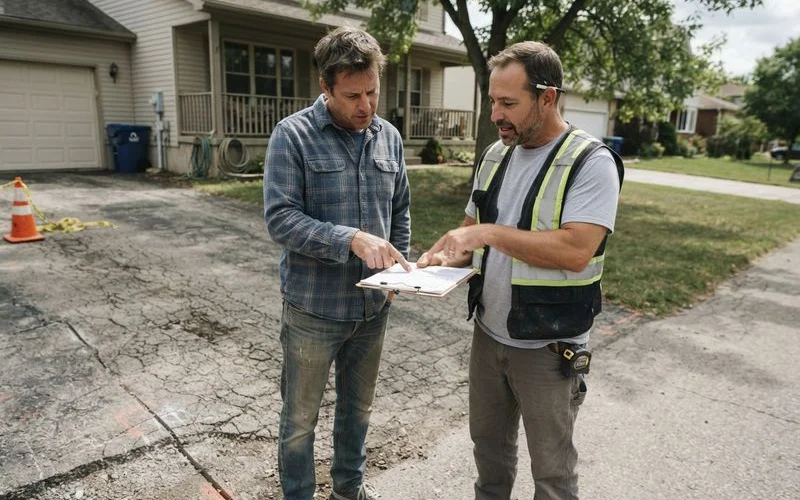
Step 5: Confirm licensing, insurance, and warranty before you sign
Ask to see proof of license and insurance rather than taking it on faith, and get the warranty terms in writing. This single step prevents most of the worst-case scenarios first-time homeowners run into, including being on the hook for damage a crew causes or having no recourse if the work fails early.
Step 6: Put everything in the written contract
Scope, materials, timeline, total cost, payment schedule, and warranty terms all belong in writing, signed before work starts. Verbal promises about “we’ll take care of you if there’s an issue” are common and usually sincere in the moment, but a written contract is what actually protects you if the relationship sours later.
Step 7: Be present for the pour and the final walkthrough
You do not need to supervise the entire multi-day process, but showing up on pour day and doing a careful walkthrough at completion, checking the finish, edges, and drainage slope, gives you a real chance to flag issues while they are still fixable rather than discovering them months later.
A realistic first-timer mistake to avoid
The most common first-time mistake is picking based on the lowest price without asking why it is lower. A dramatically cheaper bid usually means thinner slabs, less reinforcement, or skipped base prep, none of which are visible in the finished surface until the driveway starts failing years earlier than it should.
What to do if the job does not go as planned
Even with careful vetting, something occasionally does not go smoothly, a delay, a finish that is not quite what you pictured, or a question about whether the reinforcement matches what was quoted. Raise the issue directly and promptly rather than waiting until the final walkthrough to bring up everything at once. A reasonable contractor would rather fix a concern early than argue about it after final payment, and your written contract is what gives that conversation teeth if it does not go smoothly.
Our ranking methodology explains exactly how contractors in this directory are scored, which is a good place to start if you want to understand what “trustworthy” actually looks like in the data before you make your first call.
FAQ
- How many quotes should I get before hiring a concrete contractor?
- Three is a reasonable number for most residential jobs. It is enough to spot an outlier price in either direction without dragging the process out for weeks.
- Is the cheapest quote usually the best choice?
- Not necessarily. A quote well below the others often means something is being cut, commonly base prep, reinforcement, or mix quality, all of which are hard to verify after the concrete is poured and finished.
- What should be in a concrete contract before I sign it?
- Scope of work, exact materials and thickness, timeline, total price and payment schedule, and warranty terms. Anything discussed verbally that is not in the written contract is much harder to enforce later.
- Do I need to be home during the work?
- Not for the entire process, but being available on pour day and for the final walkthrough is worth arranging, since that is when you can catch issues while they are still easy to address.