What to expect when you get a concrete driveway poured, step by step
By Rod Burnett · Updated 2026-06-25
Most homeowners only go through a driveway installation once every few decades, so the process can feel opaque even after you have hired someone. Here is what actually happens between signing a contract and parking on a finished driveway. If you haven’t priced the job yet, the driveway cost guide breaks down what changes the price before you start getting quotes.
Step 1: Site prep and demolition
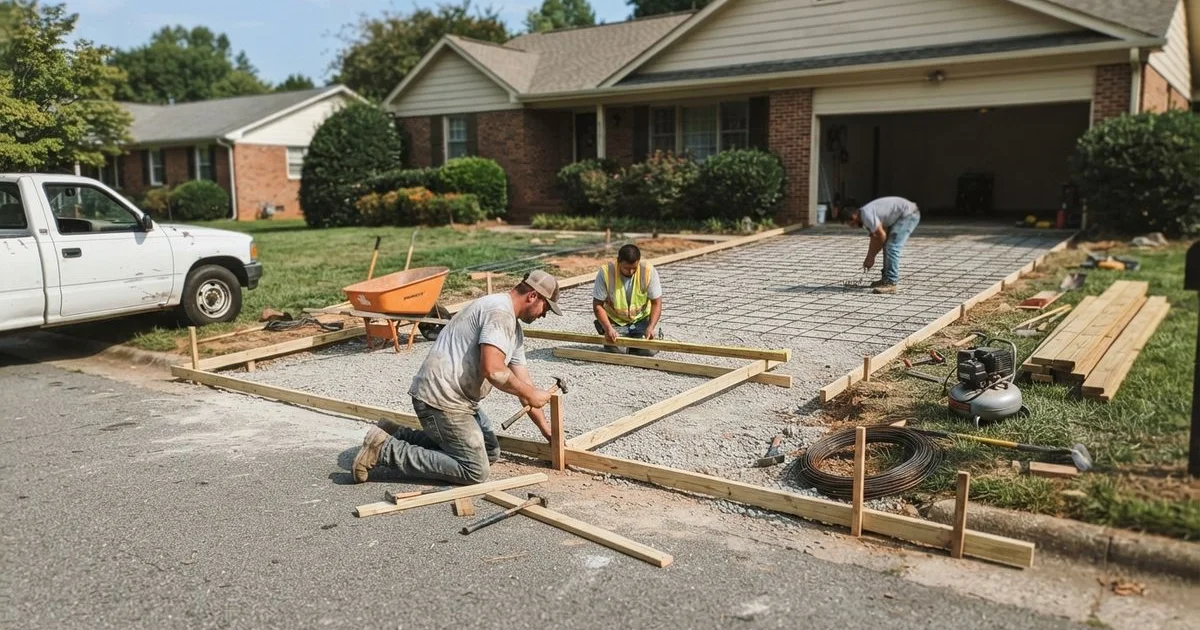
If an old driveway exists, it gets broken up and hauled away first. The crew then excavates the area to the depth needed for the new slab plus a compacted gravel base, which typically runs a few inches thick. Grading happens here too, sloping the site slightly so water drains away from the house rather than pooling.
Step 2: Forming
Wooden or metal forms are staked into place to define the exact shape and edges of the driveway. This is also when any curves, borders, or expansion joint locations get marked out. Forms need to be square and level, since any error here shows up in the finished slab.
Step 3: Reinforcement
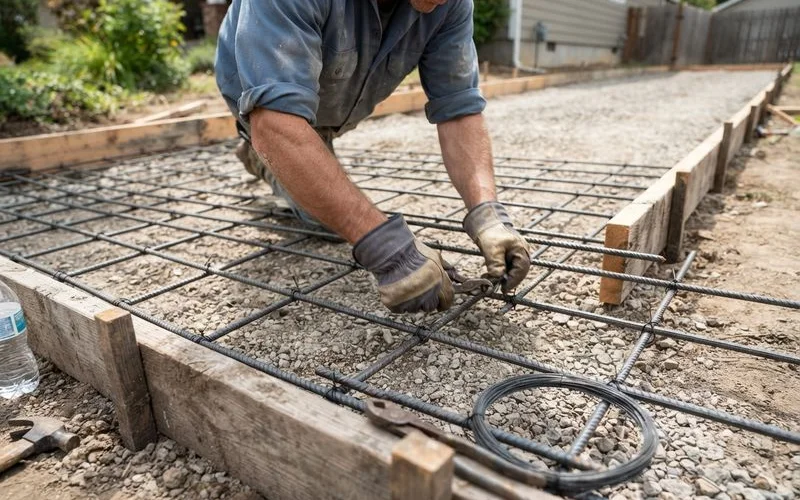
Rebar or wire mesh gets laid inside the forms before the pour, unless the job calls for fiber-reinforced concrete mixed directly into the batch instead. Reinforcement is what keeps small cracks from becoming large ones as the slab ages and the ground beneath it shifts slightly over time.
Step 4: The pour
Concrete arrives by truck and gets poured into the forms, then screeded level and worked to the specified finish, whether that is a plain broom texture, a stamped pattern, or a smoother trowel finish. This stage usually happens in a single day for a standard residential driveway, weather permitting. Control joints get cut in during or shortly after this stage to direct where cracking will occur as the slab cures, rather than leaving it to crack randomly.
Step 5: Curing
This is the stage most homeowners underestimate. Concrete keeps gaining strength for weeks after it looks solid.
| Time after pour | What it can typically handle |
|---|---|
| 24 to 48 hours | Foot traffic only |
| 5 to 7 days | Light vehicle traffic |
| 28 days | Full strength, regular use including heavier vehicles |
A curing compound is often applied right after finishing to slow moisture loss and help the concrete cure evenly, especially in hot or windy weather.
Timeline you can plan around
Including permitting, scheduling, and cure time, a full driveway project typically runs one to two weeks from the first day of demolition to the day it can safely handle regular vehicle traffic. The pour itself is fast; the waiting afterward is what protects the investment.
What can slow things down
Weather is the most common delay. Concrete cannot be poured safely in freezing temperatures without special additives, and heavy rain right after a pour can damage the surface finish before it sets. Site access problems, like a truck that cannot get close enough and requires wheelbarrow relays, also add time and sometimes cost. A good contractor will flag weather and access risks before the pour date, not after.
Material delivery timing matters too. A ready-mix truck typically has a limited window to deliver and place concrete before the mix starts to set in the drum, so a delay in site readiness on pour day, forms not finished, an inspection not yet signed off, can push the entire schedule back to another day rather than just a few hours.
What separates a good pour from an average one
The steps above are roughly the same on every job. What varies is attention to detail at each stage: whether the base gets properly compacted rather than rushed, whether control joints are spaced and cut at the right depth, and whether the crew adjusts finishing technique for the day’s weather instead of following the same routine regardless of conditions. These details are hard for a homeowner to judge in real time, which is part of why reputation and past workmanship matter as much as the written scope of work.
Choosing who does the work
The process above is roughly the same across contractors, but execution quality varies a lot in the details: how well the base is compacted, whether control joints are placed correctly, and how carefully the crew finishes the surface in changing weather. Our directory of driveway installation and repair contractors lists local crews scored on workmanship and reliability from real customer feedback, which is a useful way to compare before you commit to a start date.
You can see how those scores are built on our ranking methodology page, and browse the full directory homepage to compare contractors across every category we track in Charlotte Metro.
FAQ
- How long does it take to pour a new concrete driveway?
- The pour and finishing itself usually happens in a single day for a typical residential driveway. Including prep, forming, and cure time before it can handle vehicle weight, the full process from start to drivable usually spans one to two weeks.
- When can I actually drive on a new driveway?
- Concrete is generally safe for foot traffic after a couple of days, but most contractors recommend waiting at least 7 days before light vehicle traffic and closer to 28 days before it has reached full strength for regular heavy use.
- Do I need a permit before a contractor can pour my driveway?
- It depends on your municipality and whether the new driveway affects drainage, a public right-of-way, or a curb cut. A licensed local contractor should know the requirements for your specific address and typically handles the permit application as part of the job.
- What should I do to prepare my property before the crew arrives?
- Move vehicles out of the driveway and street parking area for the full timeline the contractor gives you, clear anything stored in the work area, and confirm where equipment and material delivery trucks will park, since access matters for both cost and scheduling.